




News and Articles
Study of RFID in the Retail Warehouse: An Example from Central Marketing Group (CMG) Warehouse
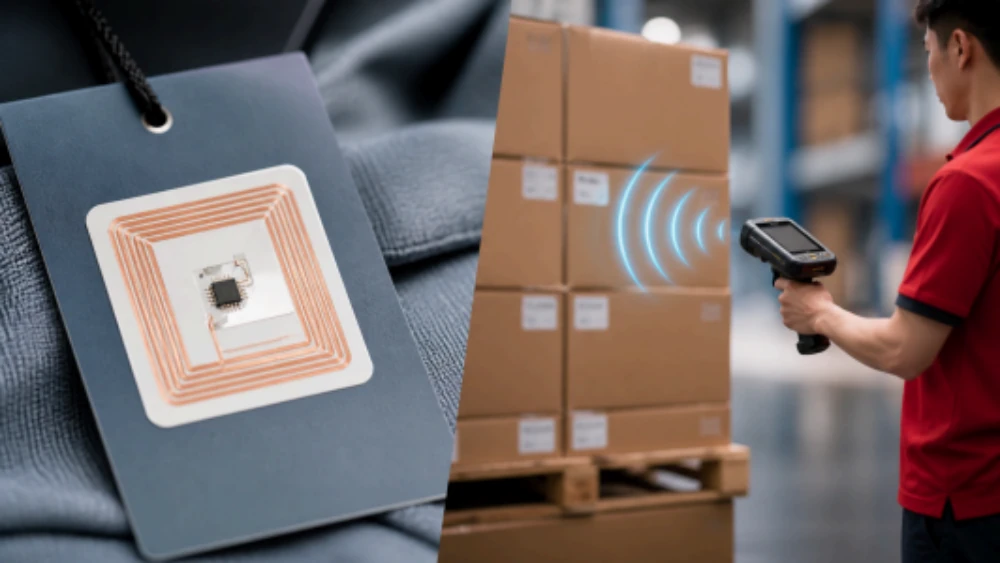
A study on applying RFID to retail warehouses, using CMG Warehouse as an example
Central Group has long been part of everyday life for Thai consumers, covering a wide range of categories — from Fashion, Beauty, Watches, Technology, and Home Appliances to lifestyle and household goods.
Imagine buying everyday items — a new outfit, a favorite watch, your go-to skincare, or a piece of home appliance / technology — from a Central department store. Behind every product that reaches the shelf or your doorstep, there is a large-scale back-end logistics system at work, operated within the group by Central Retail Logistics (CRL).
In today’s fast-paced retail environment, RFID (Radio Frequency Identification) is one of the technologies that retailers around the world are studying and exploring for warehouse modernization. This article walks through a study of how RFID can be applied to retail warehouses, using CMG Warehouse — one of CRL's warehouses, as an example case to evaluate the limitations of the existing process and how RFID could help, and what challenges must be managed before any real-world rollout.
CRL and CMG Warehouse in 60 Seconds
Central Retail Logistics (CRL) is the end-to-end logistics arm of Central Group, providing both Warehouse and Transport services across multiple business units in the group, including Central Marketing Group (CMG).
CMG Warehouse is one of CRL's warehouses, handling a diverse set of categories in lifestyle and beauty:
💄BEAUTY: Cosmetics and skincare from various brands
👗FASHION: Apparel, footwear, and lifestyle fashion
💻TECHNOLOGY: Tech gadgets and smart devices
⌚WATCHES: Fashion and functional watches
Given the diversity of products and the high daily inbound/outbound volume, CMG Warehouse serves as a useful illustrative case for studying how RFID could be applied — as a basis for considering broader rollout in the future.
🔍 The Existing Issue: Why Item-by-Item Scanning Became a Bottleneck
Most warehouses still rely on barcodes — scanning one item at a time. This produces a familiar set of pain points:
⚠️ Limitations of the traditional Process
- Goods Receive — open every box, scan each piece, manually verify against documents
- Put Away — 1:1 scan between item and storage location, time-consuming
- Dispatch — every item scanned before loading, prone to missed pieces
- Stock Take — 100% manual count, labor-intensive, with long cycle times
- At the Store — cashiers scan items individually; daily stock counts are difficult
The result: lost time, accumulated errors, and inventory data that is never quite real-time — all of which becomes a hidden cost passed along to brands, retailers, and ultimately consumers.
📡 What is RFID?
RFID is a tiny tag — embedded with a chip and antenna — that is attached to a product. When in range of a reader, it broadcasts a unique ID. No line of sight, no opening boxes, and the reader can capture hundreds of items at once.
📊Barcode (As is)
Laser must point directly at the line, one piece per scan, requires unboxing
📡RFID (To be)
Every tag responds in seconds, no unboxing needed
⚙️ If RFID Were Applied at CMG Warehouse — What Could Change?
From an early study, applying RFID in a retail warehouse generally falls into three core areas — extending from inside the warehouse all the way to the storefront
🔴 1. Direct Warehouse — Faster Receive, Store, Ship
🔄 From "Piece-by-Piece" to "Bulk Scan"
Inbound (GR/RTW) → Bulk Scan whole pallet → Carton-level Put Away → Dispatch with no error
✅ Benefits
- Significantly faster and more accurate
- Eliminates duplicate scanning steps
- Real-time inventory updates in WMS
⚠️ Things to Manage
- Additional cost
- System integration and staff training
- 100% re-tagging of existing inventory
🟡 2. Indirect Warehouse — Faster Stock Counts
Stock take is traditionally one of the heaviest jobs in any DC, especially in facilities with diverse categories and many brands.
If RFID were applied:
- Staff walk past racks; readers capture hundreds of tags per second
- The system performs auto-reconciliation against the master database
- Process shifts from "100% manual count" to "RFID scan + random verification"
- Cycle time can be reduced significantly — actual gains depend on each warehouse's scale and context
🔵 3. External — Potential to expand to stores and customers
The benefits of RFID are not limited to warehouses and can further enhance retail operations and customer experience.
🛍️ Daily In-store Stock Counts Shelves are accurate, no over-/under-stocking, staff focus more on customers
💳Checkout Bulk scan replaces piece-by-piece scanning, shorter queues, fewer cashier errors
🔍End-to-End Visibility Factory → DC → store → customer in real time
🛡️ Reduced Shrinkage Item locations are always known, minimizing product loss in stores
🚀 Future Outlook
If the study and pilots at CMG Warehouse trend positively, future directions worth exploring may include:
- Considering step-by-step expansion to other facilities, where appropriate
- Linking RFID data with AI forecasting for replenishment
- Combining RFID with robotics & automation (Sorters)
✅ Conclusion: RFID Is Worth Studying as a Path to a Smarter Warehouse
Refer to global case studies and an examination of real warehouse processes, RFID shows clear potential to make receiving, storage, stock counting, dispatch, and in-store work more accurate and faster.
Using CMG Warehouse as an illustrative case helps make the opportunities and challenges more concrete — and provides a useful starting point for evaluating the right approach for each warehouse's context going forward.