







News and Articles
Case Study: Unlocking Put-to-Light Efficiency via Machine Pooling – Elevating Import & Domestic Warehouse Management to Peak Optimization
In an era where supply chain management must constantly navigate volatile inventory volumes, leveraging technology and automation to boost speed and accuracy is no longer optional—it is essential. However, the modern challenge for warehouse executives has shifted from merely adopting technology to maximizing asset utilization across all operating hours (Asset Optimization).
This case study highlights the success of implementing a Machine Pooling strategy with a Put-to-Light system. This approach effectively broke down traditional Siloed Operations between the Product Allocation workflows of both Import and Domestic business units.
1. Pain Points: Siloed Operations and Alternating Bottlenecks
Historically, warehouse floor plans and sorting equipment were strictly segregated based on product origin:
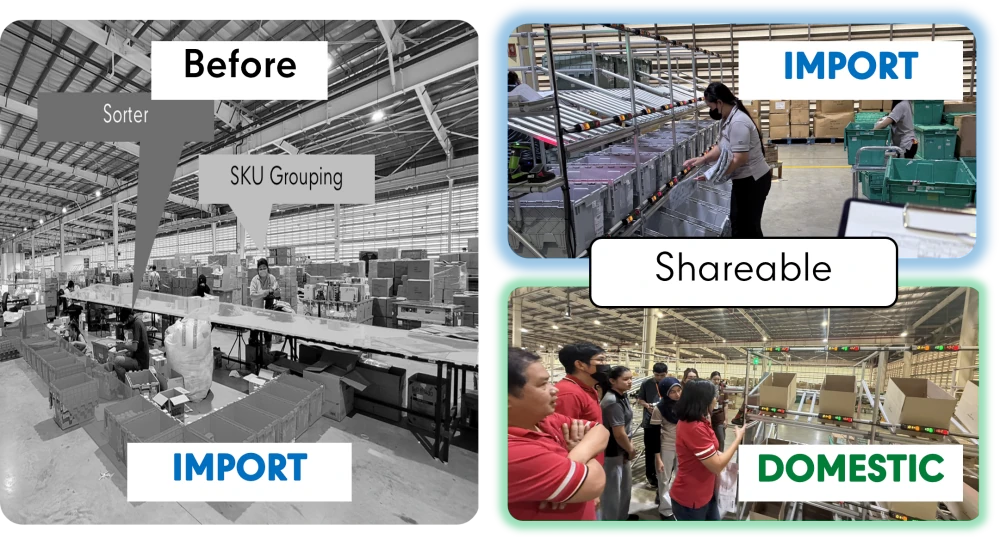
- Demand Mismatch: While the Domestic department faced massive inbound surges (Peak Load) that overwhelmed traditional manual sorting and created severe bottlenecks, the Import department experienced lower volumes (Off-Peak). Consequently, the Put-to-Light infrastructure dedicated to Import sat idle (Idle Time), leading to resource waste.
- Lost Productivity Opportunities: The inability to dynamically shift workloads across to vacant machinery resulted in a company-wide Resource Underutilization. This ultimately restricted the organization's ability to accelerate product distribution to retail storefronts when needed most.
2. Solution: "Machine Pooling" Strategy Integrated with Put-to-Light
To resolve these operational inefficiencies, the warehouse architecture was re-engineered around the principle of Machine Pooling (centralizing and sharing mechanical assets):
- Flexibility & Multi-Tenant Routing: The Put-to-Light control software was upgraded to handle both Import and Domestic merchandise simultaneously on a single machinery setup. The system dynamically differentiates and determines sorting paths (Routing Logic) automatically upon the Upload of the PO Type.
- Dynamic Capacity Allocation: When either business unit experiences a Peak Load, the system automatically feeds the overflow to any available Put-to-Light stations. This ensures continuous machine operation with zero downtime.
3. Investment Logic: Low Capital, High Asset Utilization
Implementing Machine Pooling serves as a highly strategic, cost-effective investment due to:
- Minimal Capital Expenditure (CapEx): Rather than allocating millions in budget to procure an entirely new Put-to-Light system for a single department, this pooling model required investment only in software integration and minor layout adjustments. The upfront cost was a fraction of the price of new hardware.
- Reduced Marginal Cost: Every carton or SKU processed through the pooled Put-to-Light system achieves a significantly lower operating cost per unit (Cost per Unit). This is because fixed machinery depreciation and maintenance expenses are distributed across a much larger combined volume from both business units.
4. Benefits: Attaining Peak Machine Optimization
The transition to a Machine Pooling framework delivered positive outcomes across all key metrics:
- Higher Machine Optimization: The asset utilization rate increased substantially, minimizing machine idle time to near zero.
- Agility & Scale Absorption: The warehouse gained superior flexibility, easily absorbing seasonal peak volumes without requiring additional headcount or expanding the physical storage footprint.
- Speed-to-Market: Sorting and distribution lead times for both Import and Domestic categories dropped sharply, ensuring products reached storefronts and consumers with 100% accuracy and maximum speed.
Conclusion: Combining Machine Pooling with a Put-to-Light system proves that "optimizing processes and maximizing existing assets" can generate a powerful competitive advantage and tangible financial returns without always requiring heavy capital investments.